
Cables and connectors
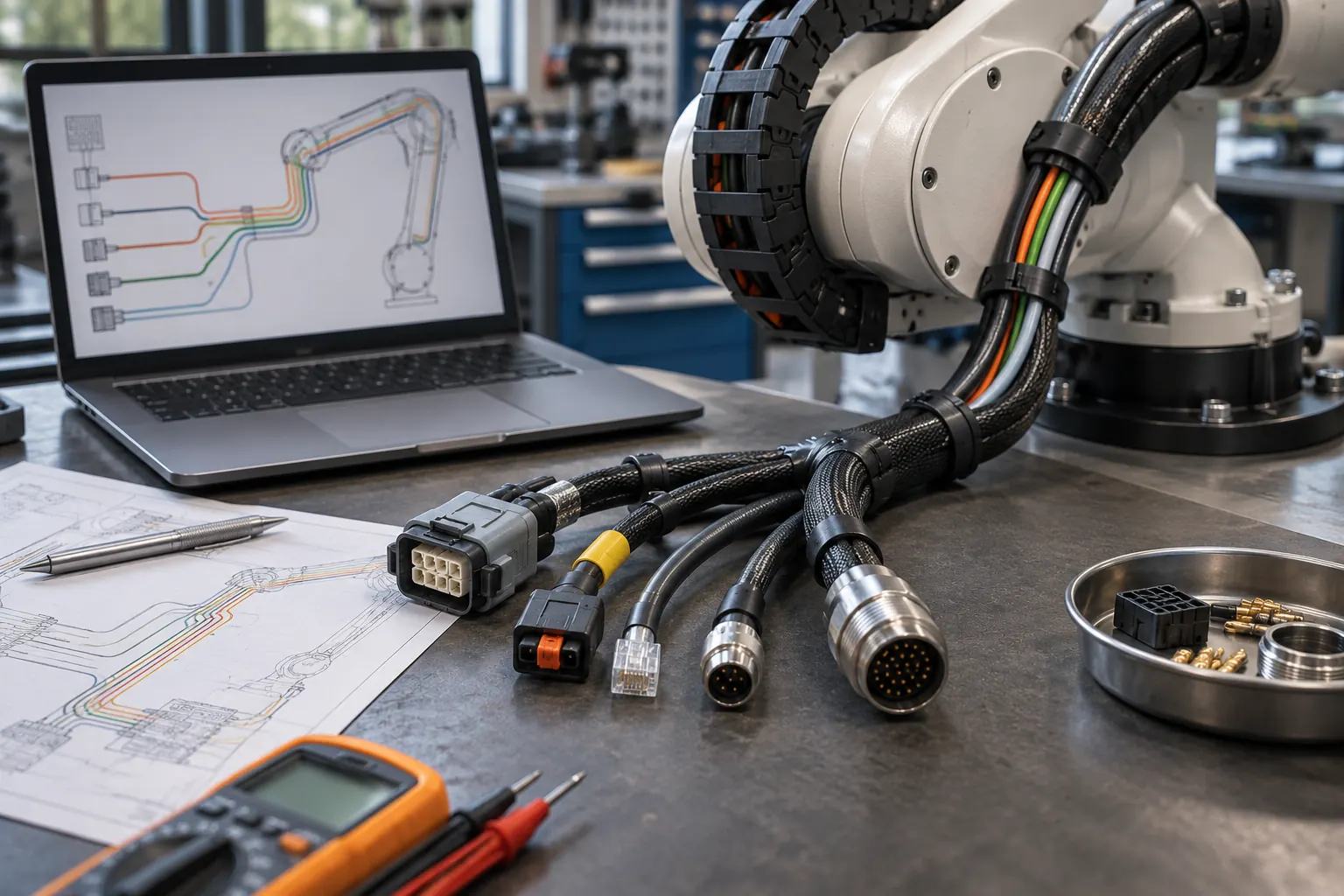
A harness is a connection map and a moving assembly. Connector keying does not establish the pin assignment, and wire colour is not an approved pinout. Identify power, feedback, communications, shielding and reference connections from applicable drawings. Include the route through the complete intended travel, the strain relief and the…
Selection considerations
How this direction works
A harness is a connection map and a moving assembly. Connector keying does not establish the pin assignment, and wire colour is not an approved pinout. Identify power, feedback, communications, shielding and reference connections from applicable drawings. Include the route through the complete intended travel, the strain relief and the replacement access. A cable can pass a static continuity check yet fail when routed through motion; conversely, a controller symptom does not prove the cable is defective. Functional checks must follow the equipment procedure and use the appropriate personnel, without experimenting with unidentified live pins.
A practical review sequence
- Photograph labels, routing and strain relief before removal.
- Create a pin-by-pin drawing comparison with explicit unknowns.
- Keep continuity and permitted motion observations as separate records.
A common mistake
Do not substitute a cable simply because both plugs mate.
Task-specific input
Connector markings, pinout, routing photos
Which pin map and shielding termination are approved?
Compare full travel routing and connector keying
Evidence to keep
Pin-map signoff, continuity record and motion inspection
Scope
Cable colour alone is not a pinout
Primary-source reading
[S1] Harmonic Drive Engineering Data
https://www.harmonicdrive.net/_hd/content/documents1/FBB_DifferentialGear.pdf
Specific catalogue families; not unknown gearbox ratings or remaining life.
[S2] UR-Series Service Manual
https://www.universal-robots.com/manuals/EN/PDF/Shared/service-manual_ur-series/Service_Manual_UR-Series_en.pdf
Use the applicable robot and software instructions; not a universal replacement approval.
Prepare before contacting us
Review record fields
1. Photograph labels, routing and strain relief before removal.
2. Create a pin-by-pin drawing comparison with explicit unknowns.
3. Keep continuity and permitted motion observations as separate records.
Record configuration/version, observation, unresolved item, owner and review date.
A useful conversation starts with a specific task.
Share your product, application, constraints and intended outcome.