
End effectors
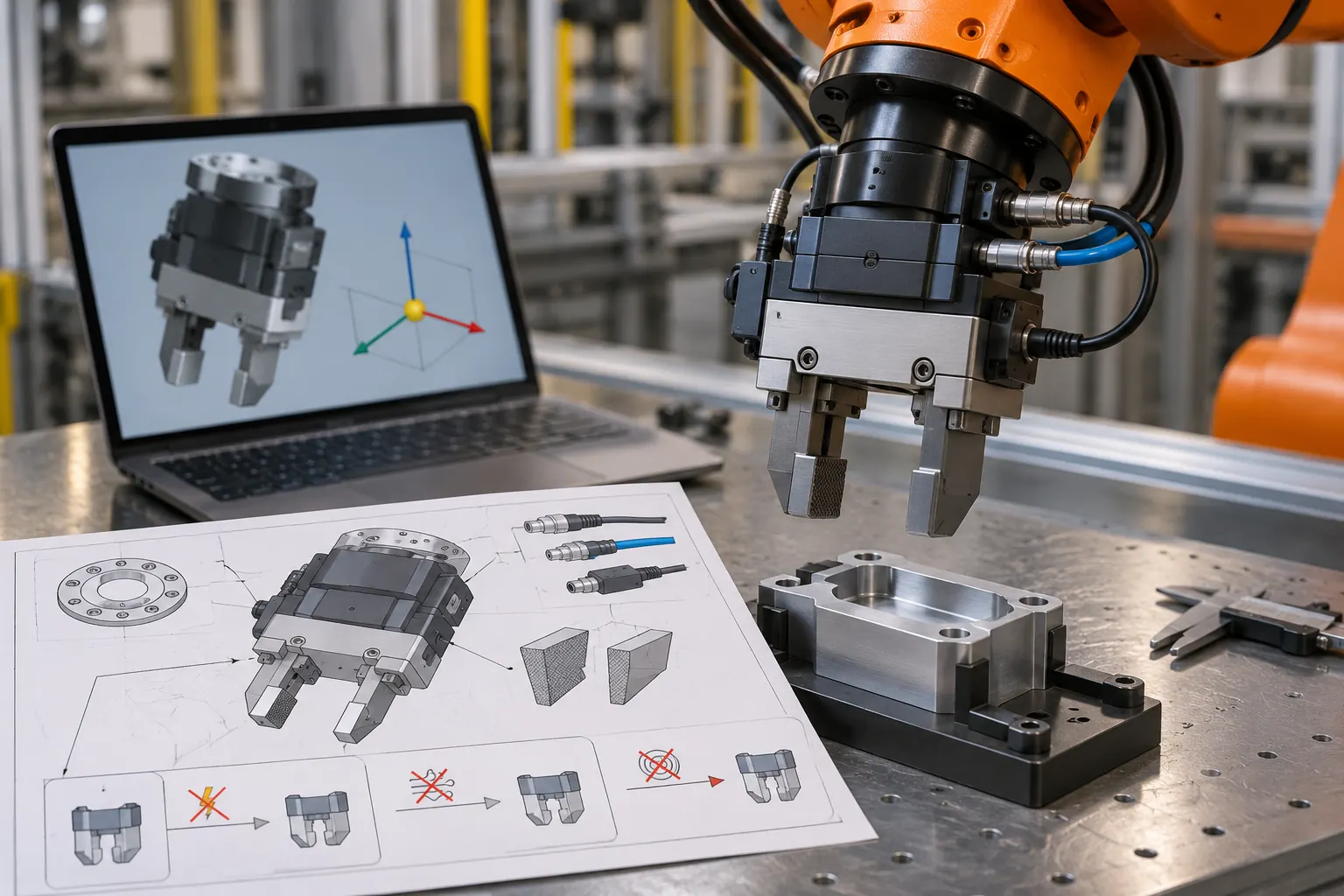
A tool replacement affects more than the flange. List the complete attached mass, the centre-of-gravity information required by the robot maker, the workpiece contact surfaces and the utility connections. Explain what the tool does if power, air or communication disappears. The tool-close command, the tool status bit and evidence that a…
Selection considerations
How this direction works
A tool replacement affects more than the flange. List the complete attached mass, the centre-of-gravity information required by the robot maker, the workpiece contact surfaces and the utility connections. Explain what the tool does if power, air or communication disappears. The tool-close command, the tool status bit and evidence that a workpiece is retained are three different things. A useful trial includes representative objects and failed attempts, not only a carefully positioned sample. When an adapter, finger or protection layer changes, preserve the version so later reviewers know which physical arrangement produced the result.
A practical review sequence
- Provide object dimensions, material, contact restrictions and tool identity.
- Map mechanical, power, air and signal connections separately.
- Agree how retention, release and unsuccessful picks will be recorded.
A common mistake
A single retained object does not validate a production cycle, safety behaviour or damage-free handling.
Task-specific input
Workpiece sample, tool mass, grip surfaces
How are tool power, I/O and mechanical flange connected?
Review retained part, failure release and changeover
Evidence to keep
Grasp trial log with released-part inspection
Scope
An isolated grasp does not validate a production cycle
Primary-source reading
[S1] Harmonic Drive Engineering Data
https://www.harmonicdrive.net/_hd/content/documents1/FBB_DifferentialGear.pdf
Specific catalogue families; not unknown gearbox ratings or remaining life.
[S2] UR-Series Service Manual
https://www.universal-robots.com/manuals/EN/PDF/Shared/service-manual_ur-series/Service_Manual_UR-Series_en.pdf
Use the applicable robot and software instructions; not a universal replacement approval.
Prepare before contacting us
Review record fields
1. Provide object dimensions, material, contact restrictions and tool identity.
2. Map mechanical, power, air and signal connections separately.
3. Agree how retention, release and unsuccessful picks will be recorded.
Record configuration/version, observation, unresolved item, owner and review date.
A useful conversation starts with a specific task.
Share your product, application, constraints and intended outcome.