
Reducers
A reducer comparison should identify the torque condition, the measured end and the definition of the published number. Backlash, hysteresis and torsional stiffness are related to motion behaviour but are not interchangeable labels. A stiffness value describes a load-deflection relationship under specified conditions; it is not a…
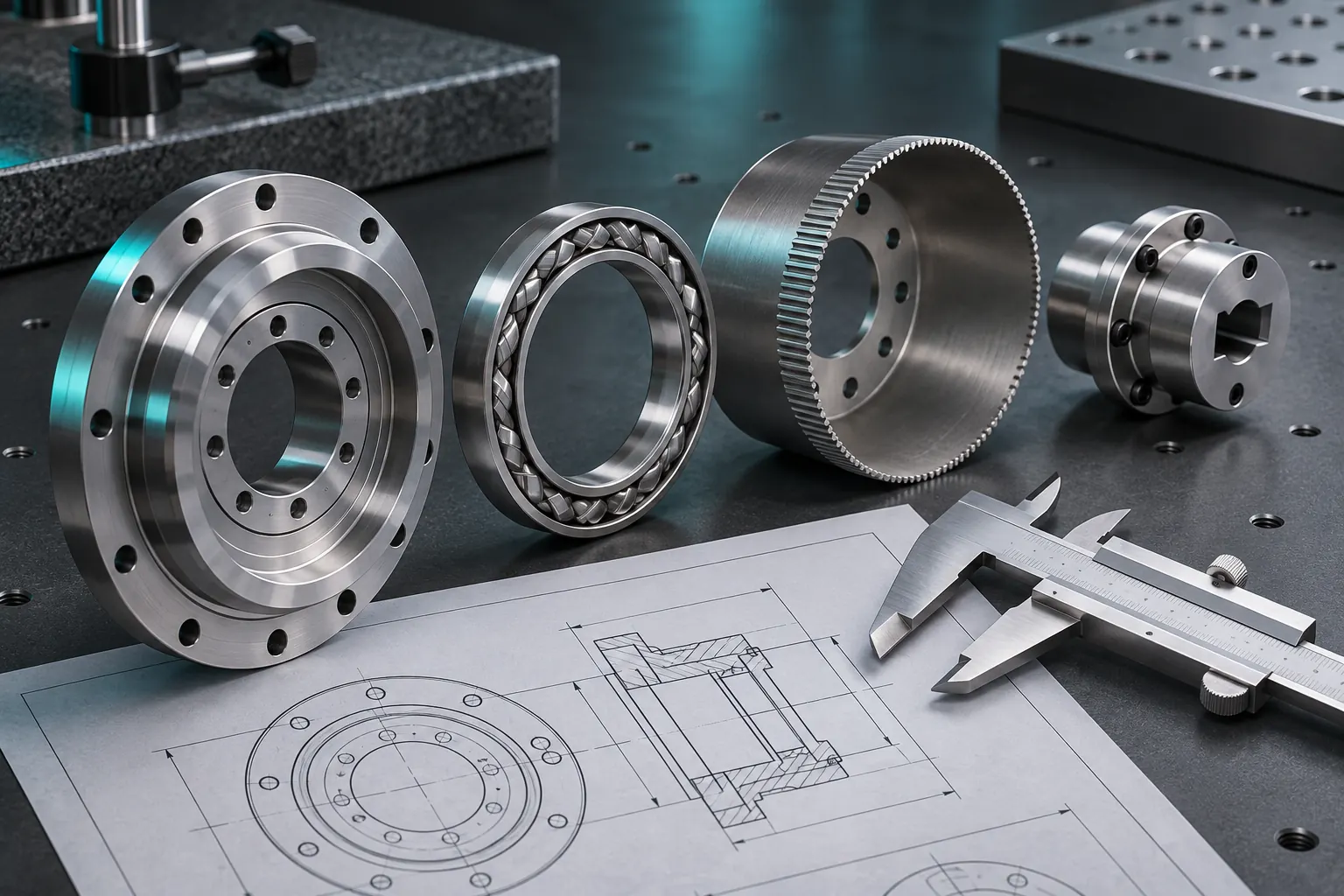
Selection considerations
How this direction works
A reducer comparison should identify the torque condition, the measured end and the definition of the published number. Backlash, hysteresis and torsional stiffness are related to motion behaviour but are not interchangeable labels. A stiffness value describes a load-deflection relationship under specified conditions; it is not a promise of zero displacement. The Harmonic Drive engineering catalogue illustrates terminology for its own product families. Its values must not be assigned to an unknown gearbox. Mounting dimensions, bearing loads, lubrication and the manufacturer service procedure remain separate questions even when a ratio matches. [S1]
A practical review sequence
- Keep the drawing revision and joint position with each enquiry.
- Record the load condition used for every stiffness or lost-motion claim.
- Confirm the actual series, mounting and approved service instructions.
A common mistake
An exterior photograph cannot establish remaining life, internal condition or a comparable accuracy rating.
Task-specific input
Joint location, load orientation, mounting drawing
How are input shaft, output flange and lubrication documented?
Check mating dimensions and service procedure together
Evidence to keep
Drawing review and before/after joint test record
Scope
Do not infer remaining life from an exterior photo
Primary-source reading
[S1] Harmonic Drive Engineering Data
https://www.harmonicdrive.net/_hd/content/documents1/FBB_DifferentialGear.pdf
Specific catalogue families; not unknown gearbox ratings or remaining life.
[S2] UR-Series Service Manual
https://www.universal-robots.com/manuals/EN/PDF/Shared/service-manual_ur-series/Service_Manual_UR-Series_en.pdf
Use the applicable robot and software instructions; not a universal replacement approval.
Prepare before contacting us
Review record fields
1. Keep the drawing revision and joint position with each enquiry.
2. Record the load condition used for every stiffness or lost-motion claim.
3. Confirm the actual series, mounting and approved service instructions.
Record configuration/version, observation, unresolved item, owner and review date.
A useful conversation starts with a specific task.
Share your product, application, constraints and intended outcome.